
Making the Most of Parent-Teacher Conferences: A Simple Guide for Families
What to Ask, What to Expect, and How to Feel Prepared
The first parent–teacher conferences of the year are here, and with them often comes a mix of emotions. For many families, this is the first chance to sit face-to-face with a teacher and hear how their child is truly settling into the classroom. That can feel exciting—finally getting a clear picture of how the year is going. But it can also bring up nerves, especially if your child is still adjusting socially or academically, or if you’re seeing challenges at home that don’t seem to match their school experience.
With a short window of time—usually just 10–15 minutes—parents sometimes leave feeling like they still have unanswered questions. The key is going in with a plan so your concerns are addressed, you understand your child’s progress, and you leave feeling confident rather than confused.
Here’s how to make the most of your conference time—and a list of thoughtful, specific questions you can bring with you.
🌼 Before the Conference: Make a Simple Plan
A little preparation goes a long way. Before you walk in, jot down:
Your child’s strengths you want the teacher to know
Any academic or social concerns you’re seeing at home
The most important questions you want answered before you leave
Even if you only bring a few notes, it helps keep the conversation focused and ensures you don’t forget something important in the moment.
📖 Questions to Ask by Topic
Below are parent-friendly, actionable questions organized by the main areas teachers typically discuss. You don’t need to ask all of them—choose the ones that feel relevant to your child.
📚 Literacy
What literacy skills is my child currently confident in? (phonics, decoding, comprehension, writing)
Are there any specific reading or writing skills you’d recommend reinforcing at home?
How is my child participating during Fundations/phonics lessons?
What type of text is my child reading in class? Is that typical for this point in the year?
How does my child approach writing—do you notice stamina, organization, or difficulty with spelling or handwriting?
What comprehension strategies does the class use? How is my child doing with oral vs. independent comprehension?
🔢 Math
How is my child doing with grade-level math concepts right now?
Are there certain math skills (number sense, fluency, problem-solving) that are strengths or areas for support?
How does my child handle math tasks—confidence, frustration, avoidance?
What strategies do you use in the classroom? Is my child able to use these strategies (number lines, manipulatives, decomposition, etc.) independently?
What can we do at home that would best reinforce current math skills?
💛 Social–Emotional / Classroom Behavior
How does my child interact with peers during group work, whole-class time, and play?
How do they handle challenges, transitions, and multi-step directions?
Do they advocate for themselves when they need help?
What strengths do you see in their classroom presence (kindness, leadership, persistence, flexibility)?
How does my child respond to feedback or redirection?
📘 Intervention Groups / Support
Has my child been part of any small-group or intervention instruction this year?
If yes: What skills are being targeted? How often do groups meet, and how is progress monitored?
How was my child identified—screeners, classroom data, or specific assessments?
If not: Are there any skills you’re watching that might need support later in the year?
What progress have you seen so far, and how will you communicate updates?
Is my child able to generalize these skills from small groups into whole-class or independent work?
How can we reinforce these skills at home in simple, manageable ways?
🏫 Overall Engagement & Classroom Experience
What does my child enjoy most about the school day?
Is there anything they seem hesitant or unsure about?
Are there daily routines or habits that would help them be more successful?
📅 If You Leave With Unanswered Questions
It’s completely okay—expected, even—to need a follow-up conversation.
If something still feels unclear or a plan is in place (especially for students receiving intervention), ask to:
Check in again in a few weeks
Schedule a longer follow-up meeting
Send an email with lingering questions
Teachers want to connect with families. As a former teacher myself, building relationships with parents was my favorite part of the job. Time constraints during conferences sometimes made that difficult, but when families reached out afterward, I was always grateful—they were advocating, asking and collaborating. That’s exactly what we want: strong partnership between home and school.
🌿 Still Feeling Like You Need More?
I’ve created a free, one-page conference guide you can download to bring with you, plus I’m always here if you want to chat through your child’s specific needs. Email me at katygleavy@wildflowerparents.com to set up a call today!
Parent–teacher conferences don’t have to feel overwhelming—when you go in with clarity and confidence, they become a powerful opportunity to support your child across home and school.
Understanding Early Literacy Support in Schools: What Parents Should Know
As a parent, hearing terms like intervention, Fundations or extra small group instruction during the early elementary years can feel overwhelming — especially if this is your first time navigating the school system. The good news? Early literacy support is designed to be proactive, skill-building, and collaborative. The earlier we identify and support foundational reading needs, the stronger a child’s long-term literacy success will be.
With training and experience in Orton-Gillingham, Fundations, and coaching teachers in early literacy, I’m passionate about helping parents understand how schools support young readers — and how families can partner in the process.
Why Early Literacy Support Matters
Many kindergarten and early elementary classrooms use structured literacy programs such as Fundations — a multisensory, systematic approach to teaching reading, writing, spelling, and early handwriting. Kids see it, say it, hear it, and move with it to help early reading skills stick.
By mid-fall, schools begin collecting both formal and informal data to understand each child’s early literacy strengths and areas of need. This helps teachers form flexible groups that target specific skills — before small gaps can grow into larger challenges.
Early intervention isn’t about labeling a child. It’s about providing just-right support at the right time to build confidence, skills, and strong reading foundations.
How Schools Provide Literacy Support: MTSS in Massachusetts
In Massachusetts, schools follow a Multi-Tiered System of Support (MTSS) — a framework that looks at the whole child and creates systems for sustainable academic, behavioral, and social-emotional success.
You may have previously heard the term RTI (Response to Intervention). While RTI focuses on academic intervention, MTSS is broader. It includes:
✅ School-wide systems and instruction
✅ Tailored supports for students
✅ Collaboration among educators, families, and specialists
Rather than reacting after a child falls behind, MTSS emphasizes early, proactive support.
The Three Tiers of Literacy Support
Although every district structures intervention slightly differently, the model below is widely used:
Tier 1
All students
High-quality classroom instruction using a structured, evidence-based curriculum (e.g., Fundations)
Tier 2
Students needing additional support
Small-group targeted instruction focused on specific skills (e.g., phonological awareness, letter-sound connections)
Tier 3
Students needing intensive support
More frequent, individualized intervention with specialists; may lead to special education referral if progress remains limited
Important: Tier 2 and Tier 3 supplement Tier 1 — they do not replace it. Students still receive core classroom instruction alongside intervention.
Most schools run 6–8 week intervention cycles, reviewing data and adjusting support as needed. Groups are flexible — children move in and out based on growth.
What Early Literacy Support Looks Like in Kindergarten
Early intervention is grounded in building the skills that create strong readers, including:
Phonological and phonemic awareness
Letter identification and sounds
Oral language and vocabulary
Early decoding and encoding (reading and spelling simple words)
For example, a child may receive a “double dose” of Fundations — one whole-group lesson plus a small-group session reinforcing the same skill. Another child may join a group focused on phonological awareness to strengthen sound-based skills before applying them to print.
These early, targeted supports help prevent small struggles from becoming persistent reading difficulties later.
A Parent’s Role — and Why Your Voice Matters
Families are an important part of literacy growth. If your child begins receiving intervention:
• Ask for updates every intervention cycle
• Celebrate small progress — confidence fuels learning
• Stay curious, not worried — early support is a strength
When schools and families collaborate, children thrive.
📍 Need Support Navigating?
If you’re looking for guidance on how to support your child’s early literacy journey at home or through school, I’m here to help.
You can always email me or head over to my website for more information, resources, and support services:
👉 www.wildflowerparents.com
P.S. A free Early Literacy Skills Guide is coming soon — stay tuned!
🌼 Early Literacy Skills Explained: Phonological vs. Phonemic Awareness (+ Playful Activities to Try at Home)
If your child is in preschool, kindergarten, or early elementary school, you may hear terms like phonological awareness, phonemic awareness, or CVC words come up during parent conferences or classroom updates. These skills are the building blocks of reading — and understanding them can help you better support your child at home.
This post breaks down what these terms actually mean (in clear parent-friendly language) and shares simple, playful activities you can use to strengthen early reading skills — including movement-based and soccer-themed games kids love!
🔤 What Is Phonological Awareness?
Insert an image of a child clapping syllables, rhyming cards, or sound games
Phonological awareness is the umbrella term for the ability to hear and work with the parts of spoken language — without needing to see or know letters yet.
It includes skills like:
Hearing and generating rhyming words
Clapping or counting syllables (pi-zza → 2, but-ter-fly → 3)
Identifying beginning sounds (alliteration)
Hearing word parts (onset & rime: c-at, s-un)
Recognizing that sentences are made up of words
🧠 Think of phonological awareness as “sound play” — children listen, clap, tap, and talk their way through early reading concepts before looking at print.
🔎 What Is Phonemic Awareness?
Phonemic awareness is a specific part of phonological awareness — it focuses on the smallest units of sound in words (called phonemes).
This includes the ability to:
Skill What It Looks Like
Isolate Sounds “What’s the first sound in sun?” → /s/
Blend Sounds /m/ /a/ /p/ → map
Segment Sounds “Dog” → /d/ /o/ /g/
Add Sounds Add /s/ to top → stop
Delete Sounds “Say smile without /s/” → mile
Substitute Sounds Change /m/ in mat to /s/ → sat
📍 Anytime you see sounds written in slashes (/c/ /a/ /t/), it means the child is saying sounds — not letter names.
🧩 Where Do Letters Fit In?
Once children are strong in sound-based skills, they begin connecting those sounds to print.
Letter recognition includes:
Naming letters (uppercase + lowercase)
Knowing the sounds letters make
Matching a letter to its sound
Recognizing letters in different fonts or handwriting
Letter knowledge is the bridge between sound play and learning to read and write real words.
⚽ Playful Phonological & Phonemic Awareness Games
Kids learn best through movement, play, and connection — especially in early childhood. Here are engaging literacy games (including soccer-themed options!) to build strong skills at home.
🧠 Rhyme Kick (Rhyming)
Skill: Producing rhyming words
How to Play:
Say a word: “cat”
Your child says a rhyming word: “hat”
Each time they rhyme correctly, they get to kick or pass the soccer ball
Keep going until someone runs out of rhymes — switch roles for fun!
⚽ Syllable Soccer (Counting Syllables)
Skill: Syllable awareness
How to Play:
Say a word like elephant
Your child does a toe tap or kick for each syllable (el-e-phant = 3)
Variation:
Set out cones labeled 1–4. Child dribbles to the cone that matches the number of syllables.
🧵 Sound Segment & Blend (Phonemic Awareness)
Skill: Segmenting & blending
How to Play:
You say a segmented word: “/d/… /o/… /g/”
Child blends: “dog!”
Switch roles — kids LOVE giving the grown-up the “sound puzzle”
This is a game you can play anywhere — in the car, on a walk, getting ready for bed.
🥅 Rhyme Goal Challenge (Rhyming)
Skill: Generating rhymes
How to Play:
Choose a “base word” like cat
Take turns saying rhymes: hat, bat, mat, etc.
Each correct rhyme = one shot on goal
If someone repeats a word or gives a non-rhyme, the turn switches!
🧸 When to Practice at Home
Short, consistent bursts work best — just 5 minutes a day can make a big difference. Try adding one of these into:
Car rides
Bathtime
Bedtime routine
Before heading to school or sports
SMALL MOMENTS ADD UP and always feel like less work and more fun!
🌱 Why These Skills Matter
Strong phonological and phonemic awareness skills:
Build confident early readers
Support decoding + spelling
Reduce future reading challenges
Create a joyful, playful foundation for literacy
Early literacy isn’t about rushing reading — it’s about nurturing sound awareness through connection and play.
📍 Need Support?
If you’re looking for guidance on how to support your child’s early literacy journey at home or through school, I’m here to help.
You can head over to resources for more early literacy freebies — including a free Phoneme Game you can download and start using at home today
You can also reach out anytime by email if you have questions or want personalized support.
P.S. A free Early Literacy Skills Guide is coming soon — stay tuned!
Red Flags vs. Gut Instinct: Trusting Yourself When “They’ll Grow Out of It” Isn’t Enough
“All kids do that.”
“It’s just a phase.”
“They’ll grow out of it.”
“My kid did that too — they’re fine now.”
“Boys will be boys.”
“She’s just shy.”
“Wow, he’s so busy!”
How many of us have heard one of these phrases when we bring up a concern about our child — looking for connection, validation, or support? If you’ve ever been brushed off with one of these comments, you’re not alone. These phrases can make parents feel dismissed, but often they’re a signal to look deeper, not step back.
Trusting Your Gut
Becoming a first-time mom during the height of a global pandemic was nothing short of challenging. I paused my career to focus on raising my little one, even after nearly 20 years working with kids — coaching, babysitting, teaching.But parenting my own child? That was entirely different.
At first, I leaned on friends who had done it before. Their amazing and loving advice got me through those early years — but at some point, I realized I needed more. The strategies that worked for other children weren’t working for mine, and I began to feel lost.
Following the Yellow Flags
Because of my background in special education, I knew how to advocate — and I started to trust my gut.
When my two-year-old began toe-walking, and at-home strategies didn’t help, I worked with his pediatrician to reach out to pediatric PT. When PT shared that his toe-walking was more sensory and vision-related, I sought out a developmental ophthalmologist — a specialist in how the eyes and brain work together, not just vision strength. New glasses in tow, the toe walking got better.
Soon after, I requested an occupational therapy (OT) evaluation — covered by insurance — to get more individualized, strategic support than what early intervention could provide at the time. This was something I knew how and why to do given my extensive special education background.
(EI is an amazing program, but it’s often stretched thin: long waitlists, staff turnover, and sometimes generalized services instead of specialists in the child’s specific area of need.)
Building a Team, Not Waiting It Out
I connected my son’s school team with his OT, ensuring the supports he needed were in place early. Then, before kindergarten, I requested an OT evaluation through the public school system so those services could start immediately — keeping momentum and regulation steady.
This process reaffirmed what I’ve always believed: early support and parent advocacy make all the difference.
Why This Matters
There were so many moments I wished I had a community that spoke the language of both parenting and developmental support — a place where “trust your gut” wasn’t just a saying, but a strategy.
Because the truth is:
“Yellow flags” matter.
Early strategies matter.
Dismissing our instincts can delay the help our kids need most.
Every parent deserves access to guidance that bridges the gap between general parenting advice and developmental understanding.
Red flags aren’t the only thing to notice — sometimes it’s the quiet gut feeling that deserves the loudest voice. 💛
What are Developmental Red and Yellow Flags
Developmental red and yellow flags are signs that a child isn’t meeting expected milestones in one or more developmental domains (e.g. motor, language, social, cognitive, adaptive).
They don’t always mean there is a disorder, but they indicate that further assessment or monitoring and support is warranted.
Early identification is critical: interventions are more effective the sooner they begin.
A particularly concerning sign is regression (losing a skill previously acquired) — this is an unequivocal red flag demanding urgent referral.
Here are some domains you might see yellow or red flags in….
Gross Motor / Motor
Crawling, walking, jumping, climbing, balance
Fine Motor / Adaptive / Manipulation
Grasping, stacking blocks, drawing, using utensils
Language / Communication
Babbling, using words, combining words into phrases, following instructions
Social / Emotional / Play / Behavior
Social interactions, pretend play, emotional regulation, interest in others
Cognitive / Problem-Solving / Adaptive
Understanding cause/effect, use of objects, problem-solving, adapting to environment
Sensory Integration
Over-responsive (hypersensitive), under-responsive (hyposensitive), sensory seeking/craving, vestibular/proprioceptive challenges, tactile/texture sensitivity, auditory/visual processing, regulation and attention
Two Hills I’ll Die On
1️⃣ Getting support does not mean there is something “wrong” with your child.
It’s about getting support early — providing both parent and child what they need to thrive, to feel regulated, and to feel successful.
2️⃣ No one has ever said, “I wish I waited longer instead of reaching out for services.”
Okay, I lied — three hills:
3️⃣ Every child and adult learn differently.
There is no one-size-fits-all. Differences should be celebrated, not brushed aside.
Research References
Early Identification of Developmental and Behavioral Problems — PMC3549694
Parental Awareness of Developmental Milestones and Red Flags — PMC10865706
Above are two research articles supporting the work in early intervention and development. The second study is particularly important — and it’s why I started Wildflower Parents. I had all of this knowledge from years of teaching special education, and I wished I had found a community with other parents navigating these same challenges,— helping them know what I knew while also feeling supported and not alone, along the way. 🌸
From Teacher’s Pet to Tiny Tornado: The After-School Meltdown Survival Guide
We’re officially one month (and a little more) into the school year—and for us, it’s the very first time doing five full days a week. What I’ve learned quickly: while my child holds it together all day at school, the second they walk through the door, the emotional floodgates open.
This after-school crash has a name: restraint collapse.
What Is Restraint Collapse?
Restraint collapse refers to the meltdowns, outbursts, big emotions, and sheer exhaustion kids experience after school. They’ve spent hours navigating routines, following expectations, and managing their feelings. For children who already struggle with emotional regulation or impulse control, the crash can feel even more intense—and, as parents, it can be overwhelming to manage.
Why Does It Happen?
Think of it this way: kids spend the entire school day “holding it together.” They’re listening, sitting still, sharing, waiting their turn, and following directions. By the time they get home—their safe place—every ounce of emotional energy has been used up. The release looks like tears, yelling, or shutting down.
Our After-School Routine
Through trial and error, we’ve built a routine that helps smooth the transition from school to home. It doesn’t prevent every meltdown (we are still in Kindergarten, after all), but it does give us structure and predictability.
Here’s what works for us:
Arrival routine – Shoes off, backpack away, wash hands.
Quick Hit of Proprioceptive input – Deep pressure squeezes with weighted blanket or body weight, body sock, foam roller rolls (take a foam roller or a rolled up towel, have child lay on couch or floor and roll their back with it), blanket burritos (roll up child like a burrito in a blanket), floor scooter board on belly around the house, animal walk game, trampoline jumps. These are a few examples.
Snack time – Always try to include protein and something crunchy. Oral input through straw, a smoothie or milk.
Quiet time – Dim lights, weighted blanket, cozy corner, and a favorite show or timed play on the tablet.
Movement break – A quick 5–10 minute slightly structured activity with low demands (like movement go fish, an obstacle course, or Simon Says, helping move something heavy: think basket of laundry, box of books to another space).
Free play / sports / homework – Once they’ve decompressed, we move on with the rest of the evening.
Giving Yourself (and Your Kids) Grace
Our Ideal Routine—But Not Every Day Is Ideal
This is our ideal routine—but that doesn’t mean it happens every day, in the exact same order, or without bumps. Yesterday, for example, we had an eye doctor appointment right after school—about 25 minutes away—and it was tough. I had to keep reminding myself that my son wasn’t giving me a hard time; he was having a hard time.
He worked so hard at school all day, then followed the doctor’s instructions and completed testing for 30 minutes straight! That’s a lot of sustained attention and focus for any child. Afterward, when the dysregulation hit, I reminded myself: change in routine, long day, extra demands—it all adds up.
I was thankful for sidewalks and quiet parking lots to squeeze in some movement, a snack pack always in the car, and an adaptable mental toolbox filled with movement and deep pressure strategies to help soothe his nervous system and bring him back to a place of “calm”. Remember: It’s not about stopping the feelings or sensitivities, but about providing what their body needs to feel peace and regulated.
Afterschool meltdowns still happen, and that’s okay. What matters is creating a predictable rhythm that gives kids the safety and space they need to reset after a long day, to lessen the dysregulation.
Because honestly, Kindergarten (and school) is hard—on them and on us! And building in small moments of calm helps everyone breathe a little easier.
Smoother Morning Transitions
The school year is in full swing. New routines, new teachers, new friends, and new feelings are everywhere. With all the excitement of the new year also comes lots of unknowns and transitions. For kids who thrive on structure, the refresh of routines and predictability can feel comforting. But at the same time, anticipation and changes can bring challenges too.
In our house, we have three non-negotiables for smoother morning transitions.
1. Morning Routine Checklists
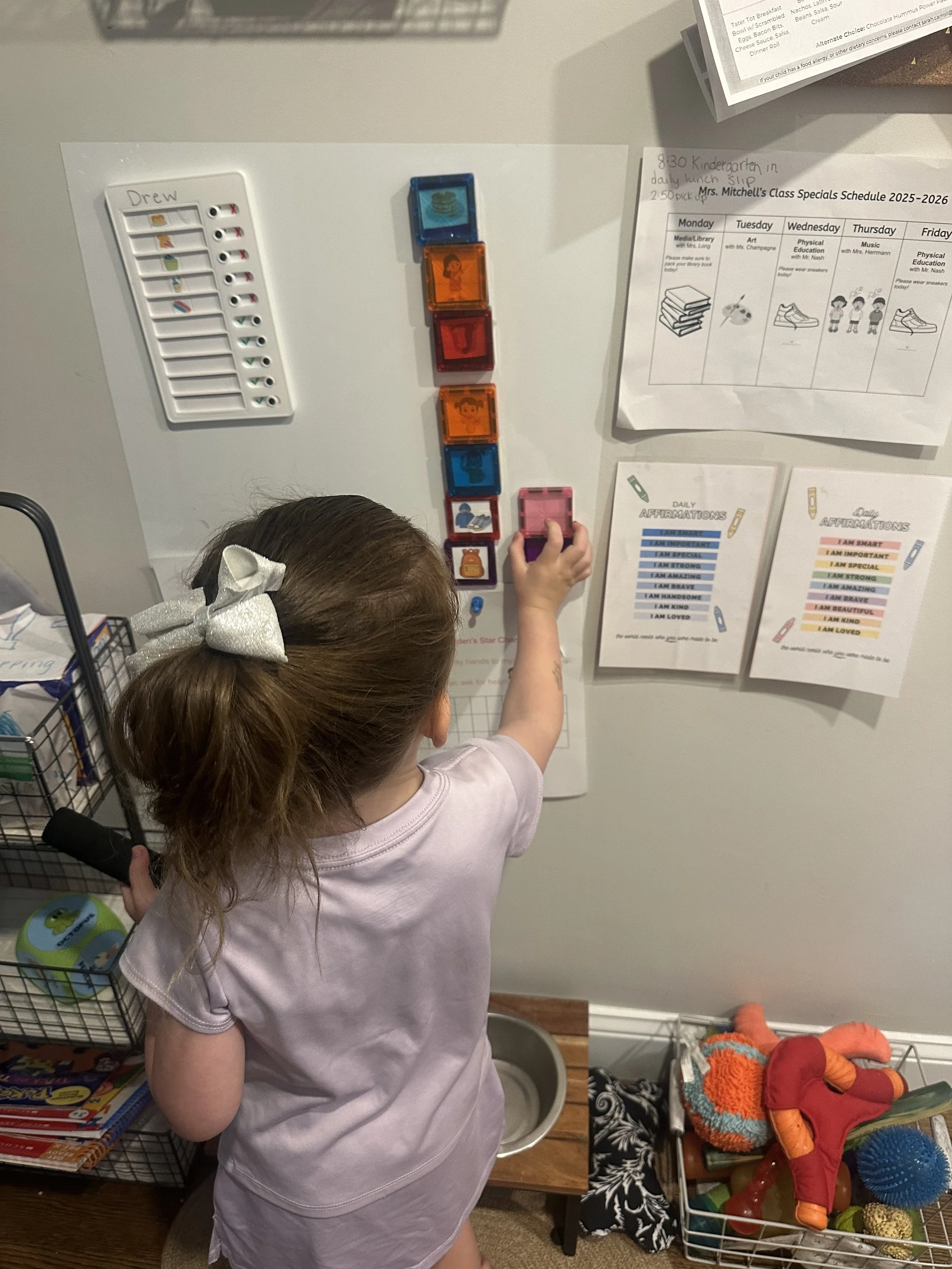
For younger kids: We utilize a checklist with pictures by incorporating the use of magna tiles! Each square magna tile has a picture that corresponds with the morning routine. (Eating Breakfast, putting our pajamas in the hamper, getting dressed, brushing our teeth and hair, shoes, and backpack) When a task is completed, a blank magnatile is placed on top of the picture magna tile. Having the kids participate and take ownership of their routine help builds independence and responsibility.
For older kids: visual sliding checklists can provide independence with morning routines. The use of a sliding checklist that has a check for a completed task, a blank or an x for an uncompleted task, can provide a quick visual cue in the rush of the morning.
Getting kids involved in a tangible, hands-on way helps them feel ownership and cooperation during the routine.
2. Limited Transitions
We simplify the number of steps needed in the morning. This can look like:
A Monday–Friday closet hanger to lay out outfits ahead of time.
Clothes brought downstairs for the morning in the same predictable spot.
A small basket on stairs or tucked away in the corner for morning pajamas, to bring to the laundry room after the morning rush.
A bathroom bin ready to go, in the downstairs bathroom or kitchen sink. A separate toothbrush, toothpaste and hair essentials. It limits trips upstairs and back and forth.
You don’t need a fancy mudroom or separate bathroom. A rolling cart or a simple bin works perfectly to keep everything accessible and minimize stress.
3. Heavy Work in the Morning
Adding heavy work to the morning routine can help kids regulate their bodies and sensory system. This might include:
Wall push-ups while brushing teeth.
Chair push-ups before breakfast.
Animal Walks during transitions (getting dressed, bathroom, backpack)
Wheel barrow walks
Trampoline jumps
Weighted blanket while eating breakfast
Crunchy (literally) breakfast items or drinking through a straw for oral input
Heavy work provides calming input and helps kids transition more smoothly into their school day.
Why These Strategies Work
Kids benefit from structure, predictability, and physical input to feel ready for the day. By combining visual supports, simplified transitions, and a little morning movement, you can reduce stress and set your child up for success.
✨ Tip: Try starting with one strategy and add on as your family gets comfortable. Small changes can make big differences in creating calmer, smoother mornings.